
AgentGeniiAutom8ly’s governance solution for AI agents

AgentGenii — Bounded Authority for Every AI Agent.

AgentGenii is Autom8ly's governance and empowerment layer for AI agents. Any compatible agent — a coding client, a custom app, even a desktop assistant — connects through a single MCP endpoint and gains scoped permissions, negotiated authority, and records of governed requests, decisions, and reported results, with coverage checked during review. It decides what an agent may do, and empowers it to do it safely.

What AgentGenii Is

AgentGenii is the empowering layer that sits between an AI agent and the systems it touches — Autom8ly's governance control plane. An agent connects to it as a single MCP endpoint and gains bounded, auditable authority without being rebuilt. Here's how it works: before an agent acts, it declares a plan — what data it needs, what systems it will touch, what actions it will take. AgentGenii reviews that plan against your policies: matching calls proceed under existing valid signed authority; requests for new authority follow the required review path, where PolicyGenii can suggest a narrower scope or route the decision to a person. After the required approval, execution authority is issued as a signed manifest — the technical artifact that enforces the task contract. Each call must satisfy its scope, expiry, remaining call allowance, and current authorization checks; authority can be narrowed or revoked at any time. The evidence records governed requests, decisions, and reported results; review its capture coverage and completeness for the deployment. It works the same whether the agent is one of ours, one of yours, or a third-party assistant.

Core Capabilities

  • Compatible agents connect through MCP; enroll the agent and register the tools it may use
  • Every request has one of three outcomes: allowed, escalatable, or forbidden
  • Approved authority is issued as a signed manifest with explicit scope, expiry, and call limits
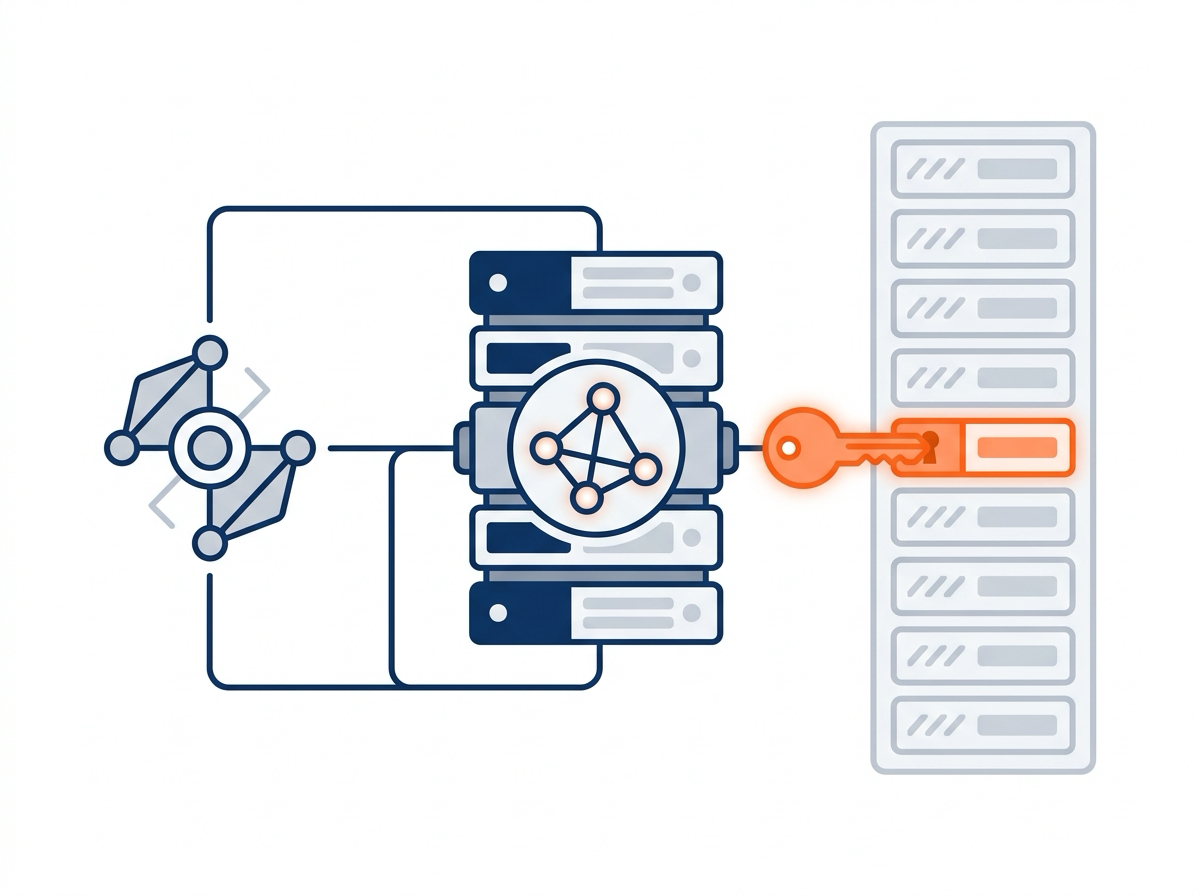
  • Governed requests, decisions, and reported results are recorded and cryptographically attributable, with coverage checked during review

How it works

One task rises through six decisions.

A useful task moves forward through clear decisions. Your assistant brings the plan. You keep authority over where it can go.

An illustrative example: prepare an invoice, then send the approved document. These are stages of one task, not physical services or a required deployment sequence.

  1. 01Identity

    The same AI.
    Different authority.

    An assistant working for a junior colleague should have different rights from the same assistant working for the CFO. AgentGenii connects the agent to the person it represents.

    Whose authority?Your permissions, the agent’s policies and the task’s limits must all permit the action. They do not add together to create broader access.
    Inside this decision

    The authenticated agent and the person it acts for are distinct identities. A requested plan does not let the agent invent its principal, environment or policy context.

  2. 02Your assistant

    “Prepare this invoice.”
    Start there.

    Your assistant identifies the records it needs, the draft it will produce and the actions it should avoid. You describe the outcome; you do not write a permission policy.

    Keep the job focusedRead the selected financial records. Prepare the invoice. Do not change the ledger or send an email.
    Inside this decision

    The assistant discovers available capabilities and their usage instructions. Discovery explains what exists; it grants no execution authority.

  3. 03PolicyGenii

    A better plan.
    A smaller boundary.

    PolicyGenii evaluates the proposed task and can challenge unnecessary access. The assistant revises its plan: for example, one customer’s records instead of an entire financial database.

    Three clear outcomesAllowed within valid authority. Escalatable through a permitted review route. Forbidden when policy excludes the action.
    Inside this decision

    Evaluation can return reasons, missing information or narrower scope. Human review is policy-dependent. An evaluation response alone is not a signed contract.

  4. 04Signed authority

    One task.
    Specific permission.

    After the required approval, signed authority makes the agreement explicit: which action, which records, how long and how many calls. A persuasive new prompt or hallucination cannot rewrite those bounds.

    Financial contractRead the selected records to prepare this invoice. Sending remains outside this contract.
    Inside this decision

    Execution authority must pass current policy and lifecycle checks. Expiry and budgets are explicit; authority does not expire merely because an agent says a task is complete.

  5. 05Governed execution

    Prepare with one contract.
    Send with another.

    The gateway checks governed calls before execution. Sending the approved invoice uses separate email authority, limited to the document and intended recipient. Access to financial records does not become email permission.

    Separate authority, even when validity overlapsThe contracts may exist at the same time. Their permissions do not merge. Document and recipient binding must be enforced by the configured workflow.
    Inside this decision

    Endpoint and credential controls must close bypass routes. This invoice workflow is illustrative and adapter-dependent; it is not a claim that every connector already enforces these bindings.

  6. 06ComplianceGenii

    A result you can use.
    A history you can review.

    Follow the task’s proposal, decisions, authority and reported result. ComplianceGenii can package governance evidence in signed vCon-based records for verification and review.

    Evidence with its limits visibleCheck capture coverage and completeness. A reported send is not automatically proof of delivery.
    Inside this decision

    Evidence supports compliance work; it does not certify compliance or guarantee complete capture. Keep the business system’s confirmation alongside the governance record where available.

The AgentGenii gateway connects these controls to governed tool calls. PolicyGenii, ComplianceGenii, KnowledgeGenii and CipherGenii work together throughout; they are not four consecutive stops. The handbook walks through the same flow in detail: How it works.

The empowering layer

One layer between every agent and your systems.

Any compatible agent connects to AgentGenii as a single MCP endpoint and reaches your tools and data through the governed path — scoped, negotiated, and evidenced.

  • Compatible agents connect through MCP; enroll the agent and register the tools it may use
  • Every request has one of three outcomes: allowed, escalatable, or forbidden
  • Approved authority is issued as a signed manifest with explicit scope, expiry, and call limits
AgentGenii illustration
The real bottleneck

Everyone can build an agent.
Almost no one can govern one.

Building the agent is the easy part. The hard part is the CISO, the AI council, the security review — the gauntlet where most enterprise AI quietly dies. It's not a lack of governance. It's the wrong kind: static permissions that are brittle and contextually blind.

78%

of enterprise AI initiatives stall in security, compliance, and procurement review — never reaching production.

Static RBAC
over-grants by default
Prompt guardrails
can be talked around
IAM scopes
blind to context
Manual review
does not scale
Mother May I · the moat

No execution without authority. Every agent negotiates for it.

“Mother May I” is the plain-language version of the question every request asks. Each answer is one of three outcomes: allowed under existing signed authority, escalatable to the person policy names, or forbidden. Everyone else firewalls agents with static, pre-defined permissions. AgentGenii inverts it: an agent declares the minimum it needs, negotiates a scoped contract, and deterministic code — not an AI — enforces it. Once it's signed, there's nothing to persuade: a prompt injection can change what the agent asks for, never what the contract allows.

Everyone else
AgentTools

Static RBAC, IAM scopes, prompt instructions. Pre-defined, brittle, contextually blind.

Autom8ly
AgentNegotiate authoritySigned contractDeterministic gatewayTools & data

Runtime-negotiated, task-bounded, cryptographically attributable authority — compiled into deterministic enforcement.
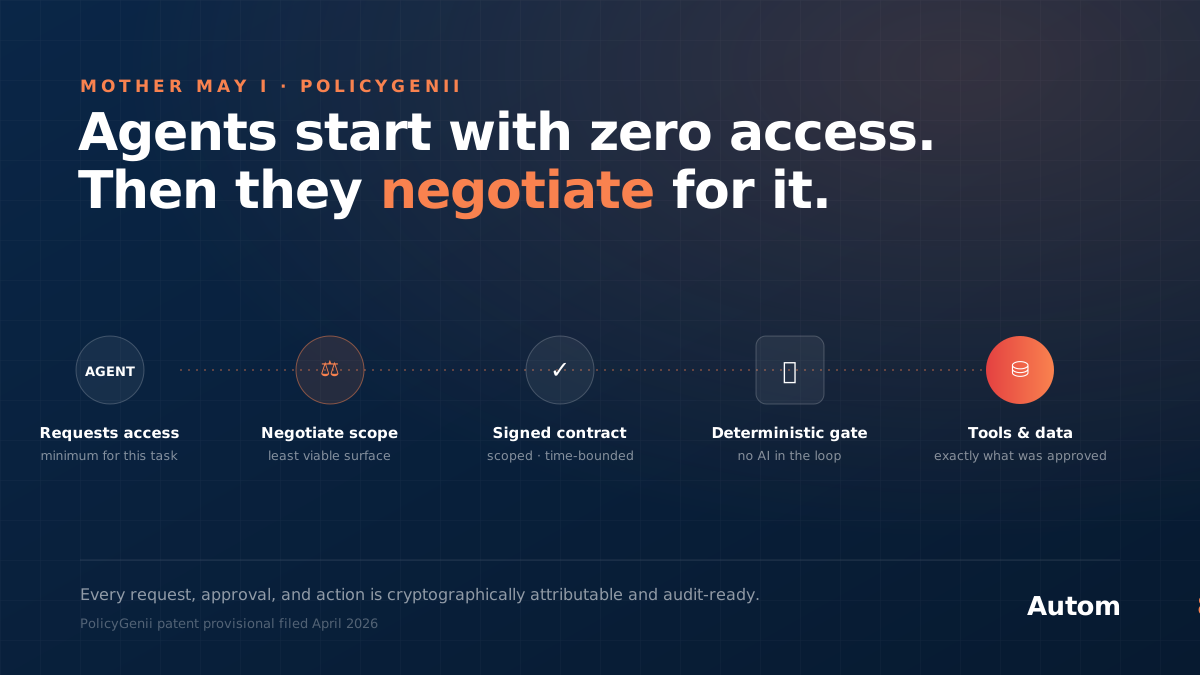
How AgentGenii governs every action: agent requests access, PolicyGenii negotiates scope, a signed time-bounded contract, a deterministic gateway enforces it, then tools & data

Deploy an agent you're not scared of.

Wire AgentGenii in as a single MCP endpoint and every connected agent works under bounded, auditable authority — connect and register, no rebuild.

Get a demo
How AgentGenii fits

Built to compose with the rest of Autom8ly’s Genii.

AgentGenii is the layer compatible agents act through — coding clients, custom apps, and assistants connected over MCP. PolicyGenii negotiates and enforces the authority, ComplianceGenii sets the outer ceiling and compiles the evidence, KnowledgeGenii governs what agents know, and CipherGenii protects data within its configured confidentiality boundary.

Explore Autom8ly solutions

Core Use Cases

1

Give your compliance team reviewable records of what governed agents requested, what was decided, and what was reported back

2

Reduce the blast radius when things go wrong — agents can't access systems they weren't approved for

3

Unblock enterprise AI adoption by answering the governance question that stalls every deal

4

Support EU AI Act, NIST AI RMF, and SOX reviews with pre-execution approval records and decision evidence

Frequently Asked Questions

Traditional permissions are like giving someone a keycard to the whole building. AgentGenii is like a visitor badge scoped to one floor, one meeting room, for one hour. Agents get exactly what they need for each task — nothing more.
It's complementary. Entra ID proves who the agent is. Agent 365 watches what it does. Defender catches threats. AgentGenii adds the missing step: ensuring the agent only does what was approved before it starts. Think of it as the approval that comes before the monitoring.
Matching calls proceed under existing valid signed authority without another approval. Requests for new authority follow the required review path, and how much needs a person is set by your policy.
No. AgentGenii sits between your agents and your systems. It works with any agent that can connect over MCP or call the action API — coding clients, custom apps, and assistants. You add governance by connecting the agent and registering the tools it may use, not by rebuilding it.
Prompts and guardrails are suggestions. An agent can be redirected by a prompt injection or unexpected input. AgentGenii enforces hard boundaries on the governed path — if a call wasn't in the approved plan, the gateway refuses it before it reaches the system, and no amount of persuasion changes the signed bounds. Close the routes that bypass the gateway with endpoint and credential controls, and it's the difference between a speed limit sign and a physical barrier.